
Posters, Brochures, Books, and More: A Look into the UWSP Print and Design Office
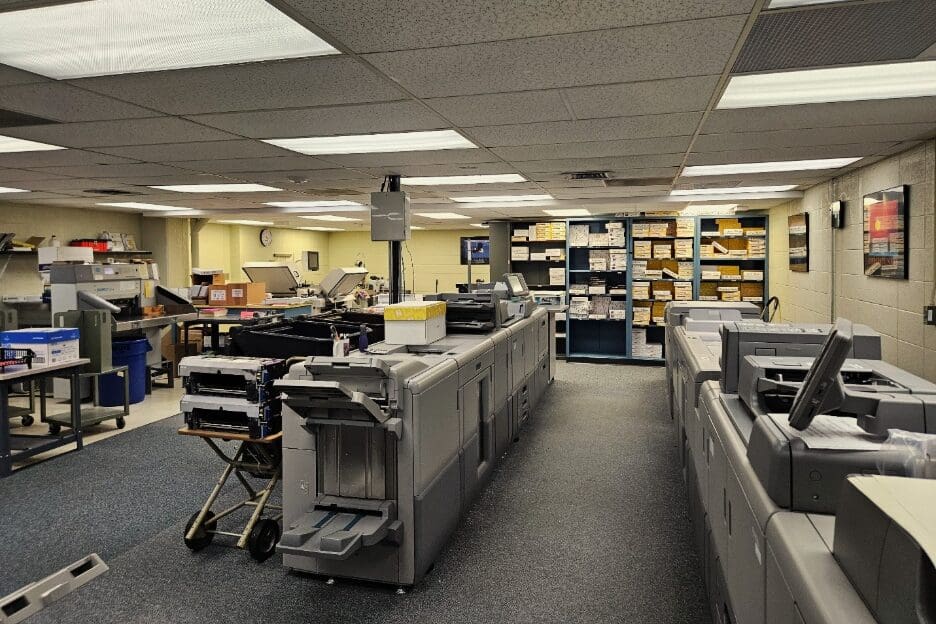
Paper for upcoming projects is shelved in the back of the main print room of the UW-Stevens Point Print and Design office.
In the basement of the University of Wisconsin-Stevens Point Science Building, a student resource operates in former chemistry labs. The UWSP Print and Design office uses specialized machinery to produce posters, banners, business cards and other materials for the university.
“We are here specifically to support students, faculty and staff, and this university,” said Robin Spindler, UWSP’s print director. “We work hand-in-hand with the graphic design students and the interior architecture students.”
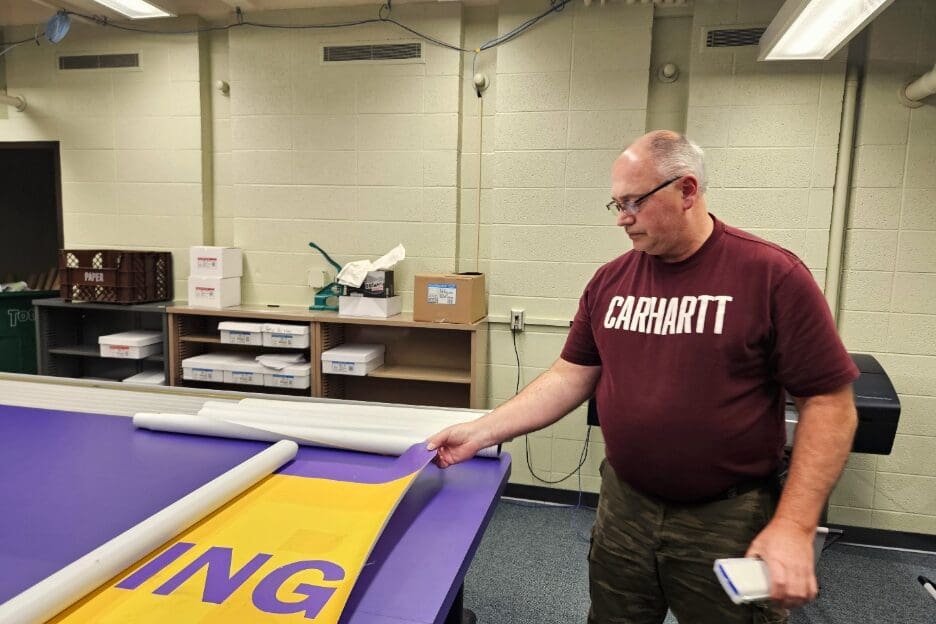
Robert Spindler
Spindler graduated from UWSP in 1993 with a major in graphic design and a minor in photography. Spindler joined the department in 2002, and he has since integrated digital tools to make the department more efficient.
“When I got here, the department was $30,000 in the hole. They didn’t have any computers that had design capabilities. Nothing was networked,” said Spindler.
Print and Design is now a functioning student resource often used in classes. The office works with graphic design professors to help students understand how their work will be printed. It also offers internships for graphic design students.
“We support academics quite a lot more than some people may realize,” Spindler said.
Former intern Kimberly Schliep-Egerer graduated from UWSP in 2019 with a Bachelor of Arts in arts management. She appreciates the opportunities and experience she gained through Print and Design. Through the office, Schliep-Egerer was connected to her first job after graduation.
“It was just a door that opened up different industry opportunities for me,” Schliep-Egerer said. “It was the Print and Design office that really taught me how to make [designs] come out right in the real world.”
Ethan Tellock, another former intern, didn’t predict that he would be working as a teacher’s aide. He shared how his experience at Print and Design prepared him for life after college and work outside his area of study by teaching him flexibility and listening skills.
“They were very open to teaching me how to do things,” said Tellock, who graduated from UWSP with a bachelor’s degree in accounting in 2025. “I learned how to be a good listener, and I learned how to apply what somebody is telling me in one situation to another situation.”
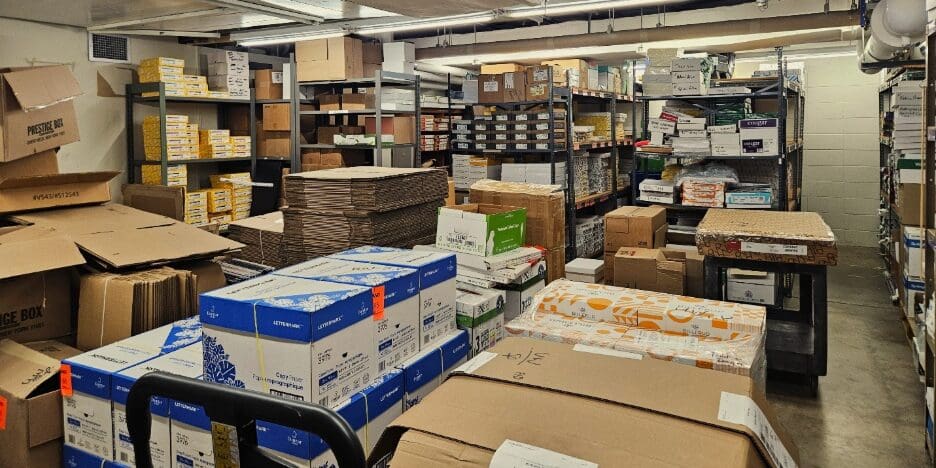
The paper room holds boxes on boxes of future projects
The university’s Cornerstone Press, a student publishing organization, also uses the Print and Design office to produce its books. Interns and staff print, fold and glue the pages into their covers.
Another way Print and Design supports the university is by keeping printing affordable. Because of its on-campus location, there are no shipping fees. Projects with 1,500 or more pieces are sent to state-contracted printers, which offer lower prices through state bids.
“We are very economical because we have purchasing power,” Spindler said.
Remaining cost-efficient is a constant challenge for Print and Design.
“The challenge is to keep our pricing low enough to make it a good idea to keep us here, but we have to keep it high enough to…cover all our overhead,” Spindler said.
The location of the office can also be an issue, with difficulties transporting materials. Spindler must move large paper shipments from the Science Building’s service doors to the basement using the service elevator, transporting the materials one dolly at a time.
Even finding the office can be a hurdle.
“A lot of people don’t even know we’re down here,” said Spindler.
“How it supports both the college and the community. That was my first time experiencing something like that,” said Schliep-Egerer.
A new intern is expected to begin next semester, continuing the office’s role in providing students with hands-on professional experience.
To use the UWSP Print and Design office, visit its website or stop by the Science Building basement. The staff can help with a variety of printing projects.
Emily Koniar
Contributor
